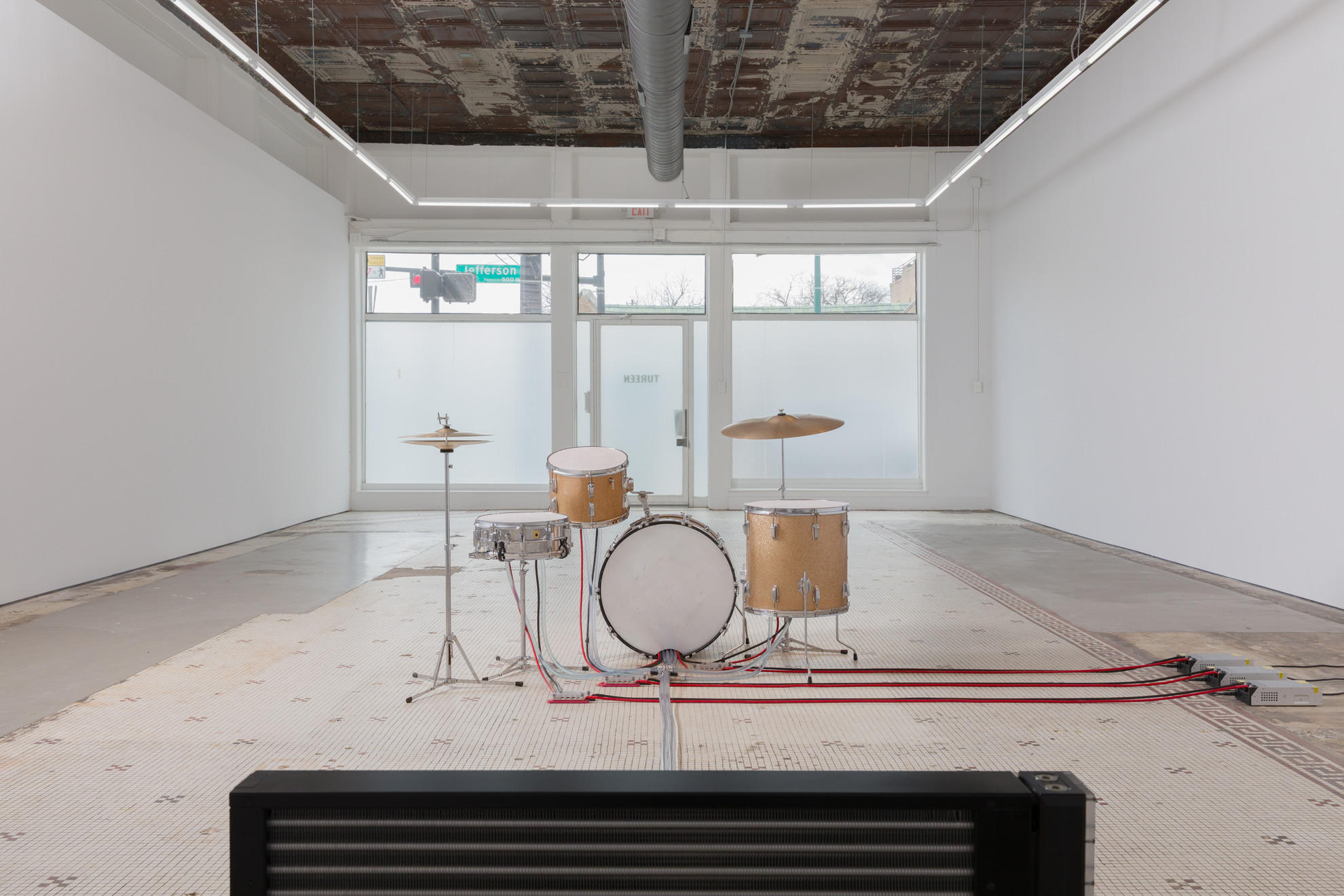
There are four laws to thermodynamics. Most remember the first: energy does not come from nowhere. You can’t create it. You can’t destroy it. You can only move it. Energy is always conserved and transformed. The second: Energy flows from hot to cold, never cold to hot. All leads to disorder, to equilibrium.
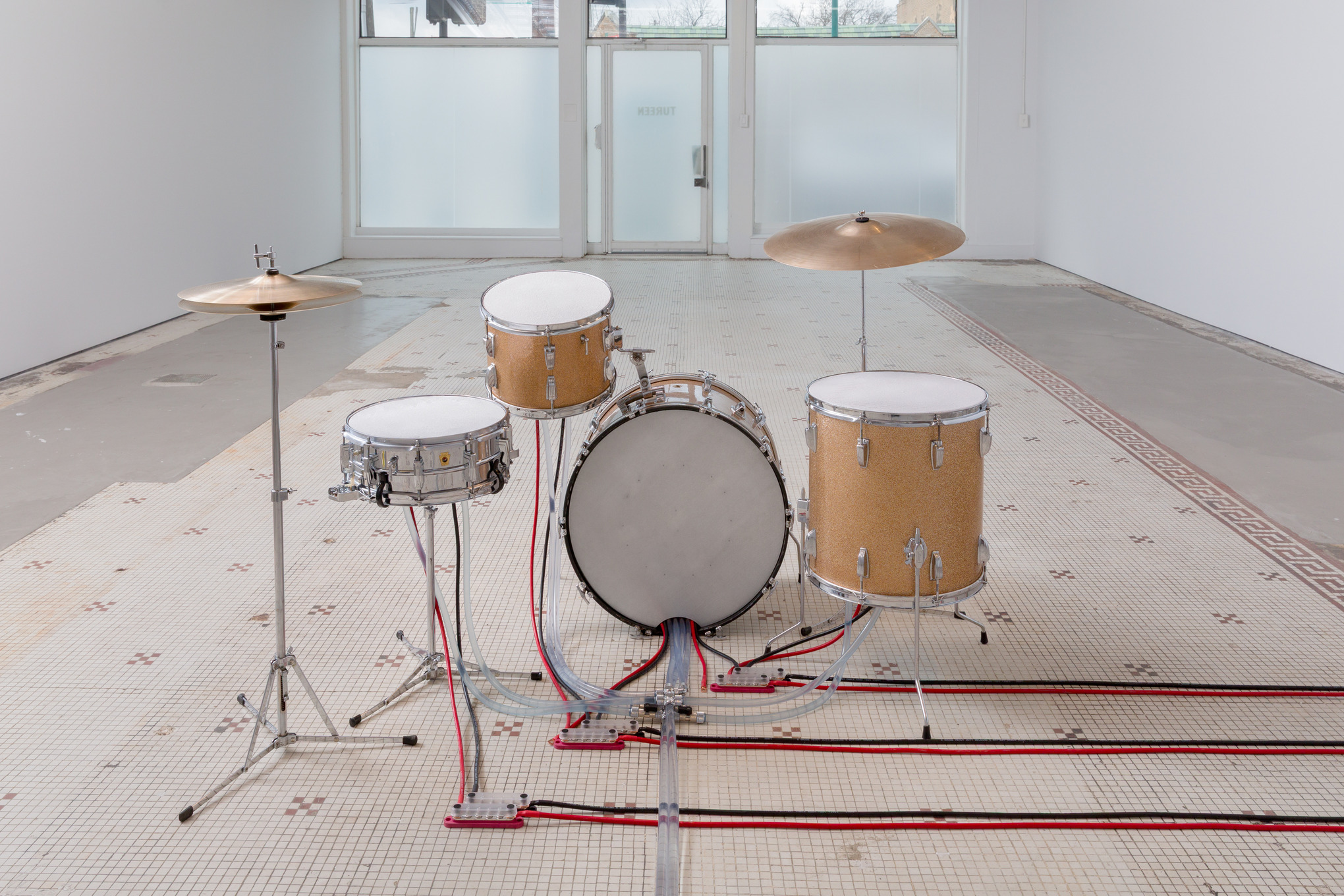
A standard drum set is also known as a trap set. The name can be traced to orchestra and theatre pits where percussionists assembled “contraptions” by mounting their instruments to the bass drum or specialized stands to keep everything within reach. Contraptions also reduced the number of percussionists needed by an orchestra—with the addition of a foot pedal for the bass drum, a single percussionist could play an entire section.
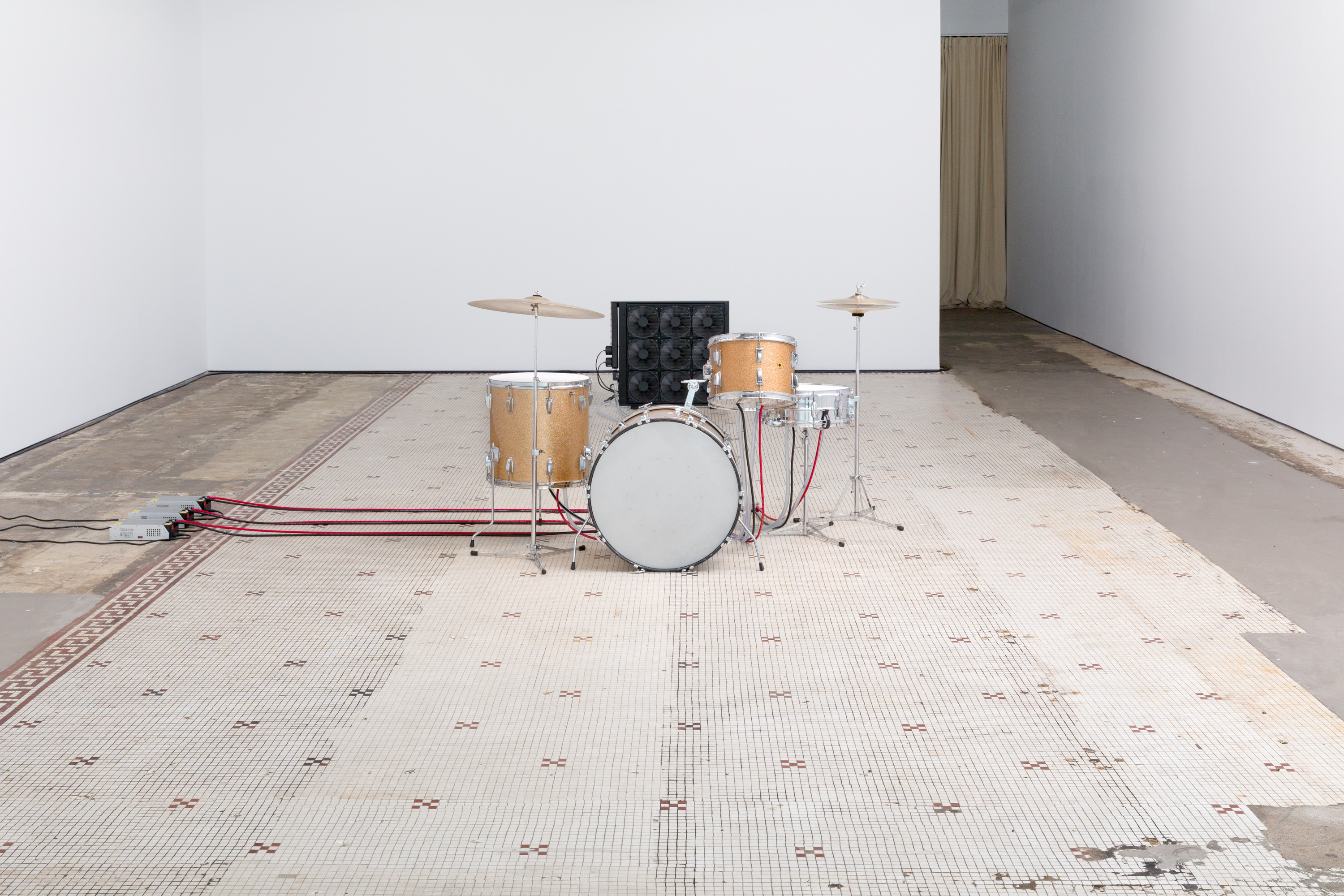
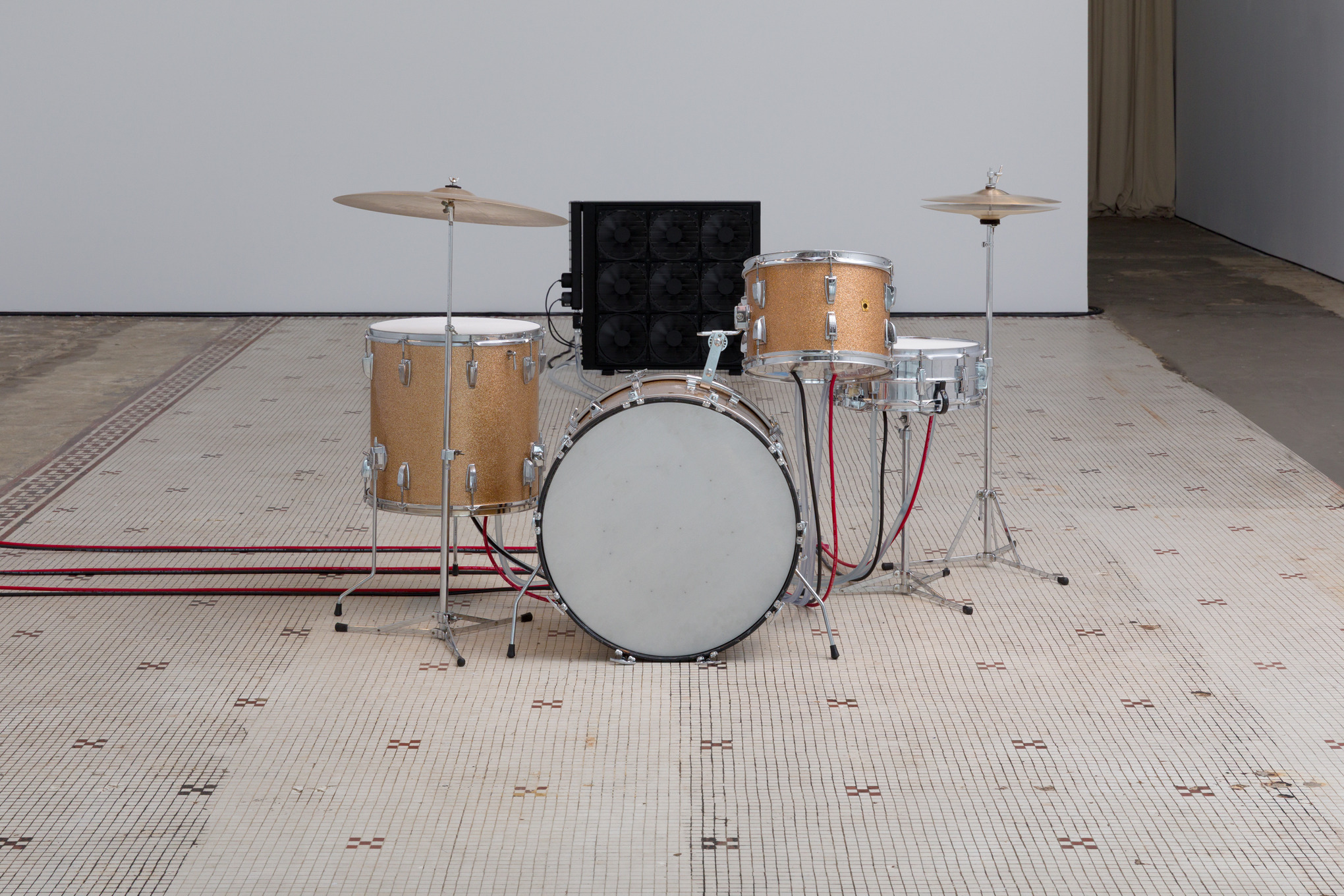
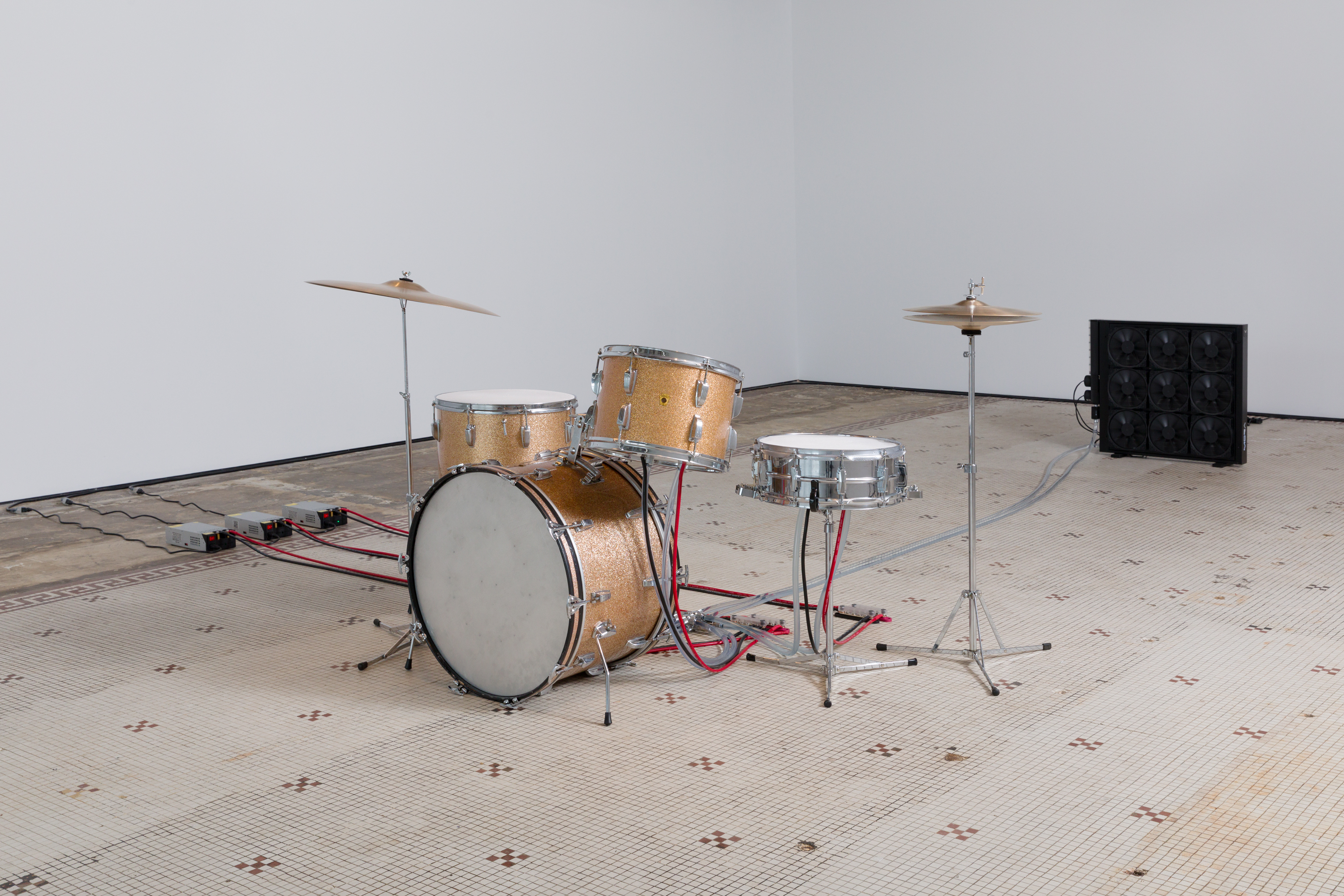
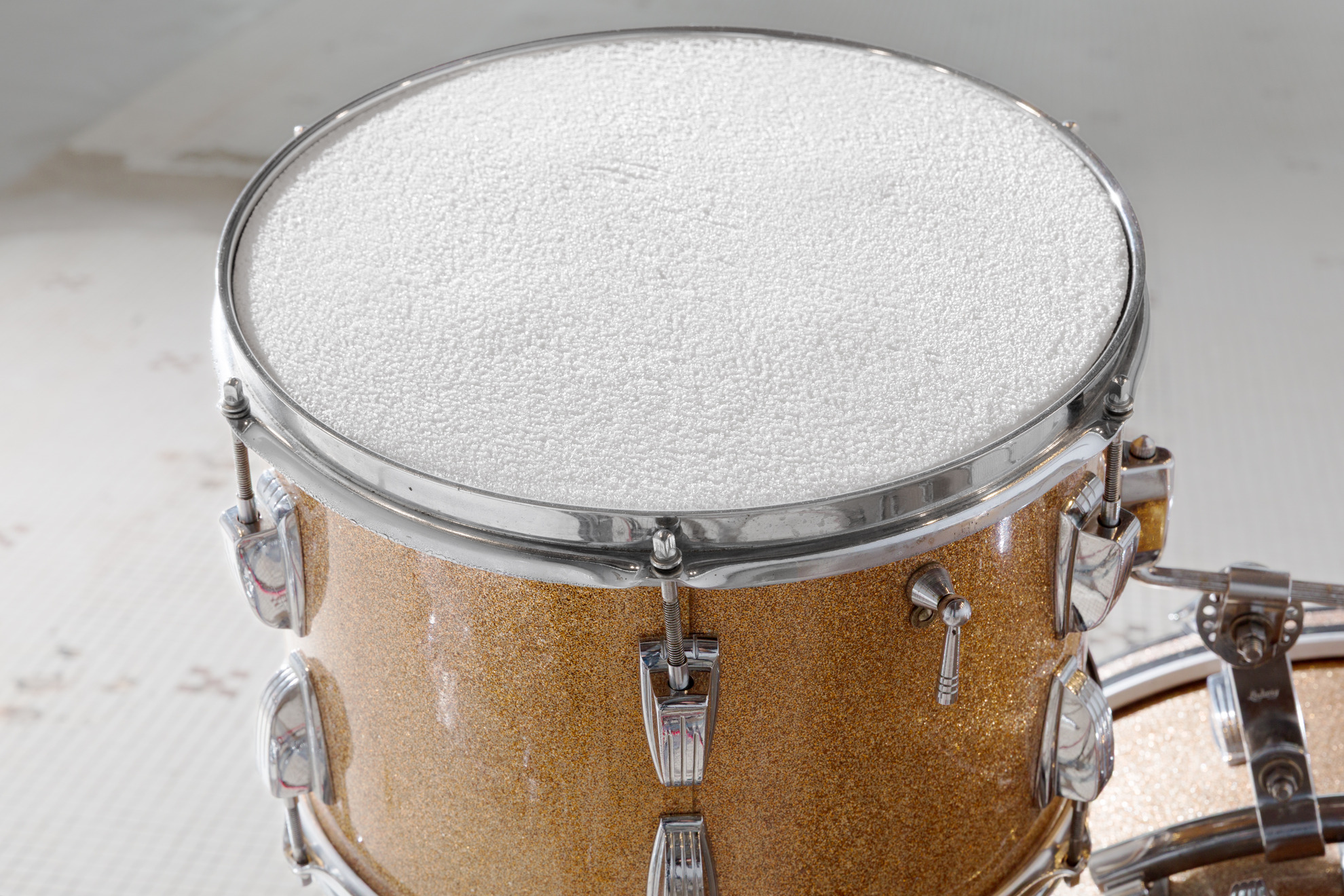
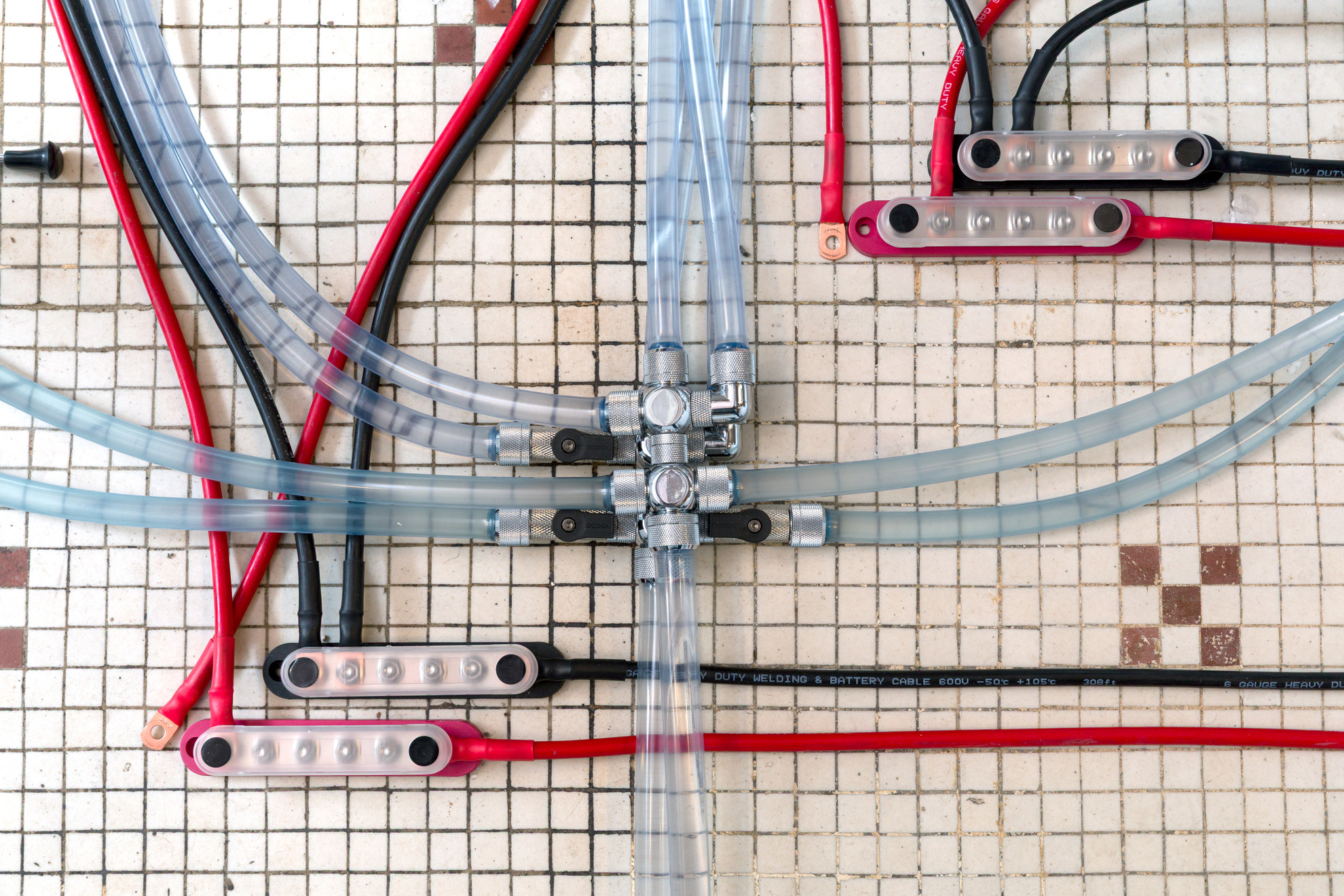
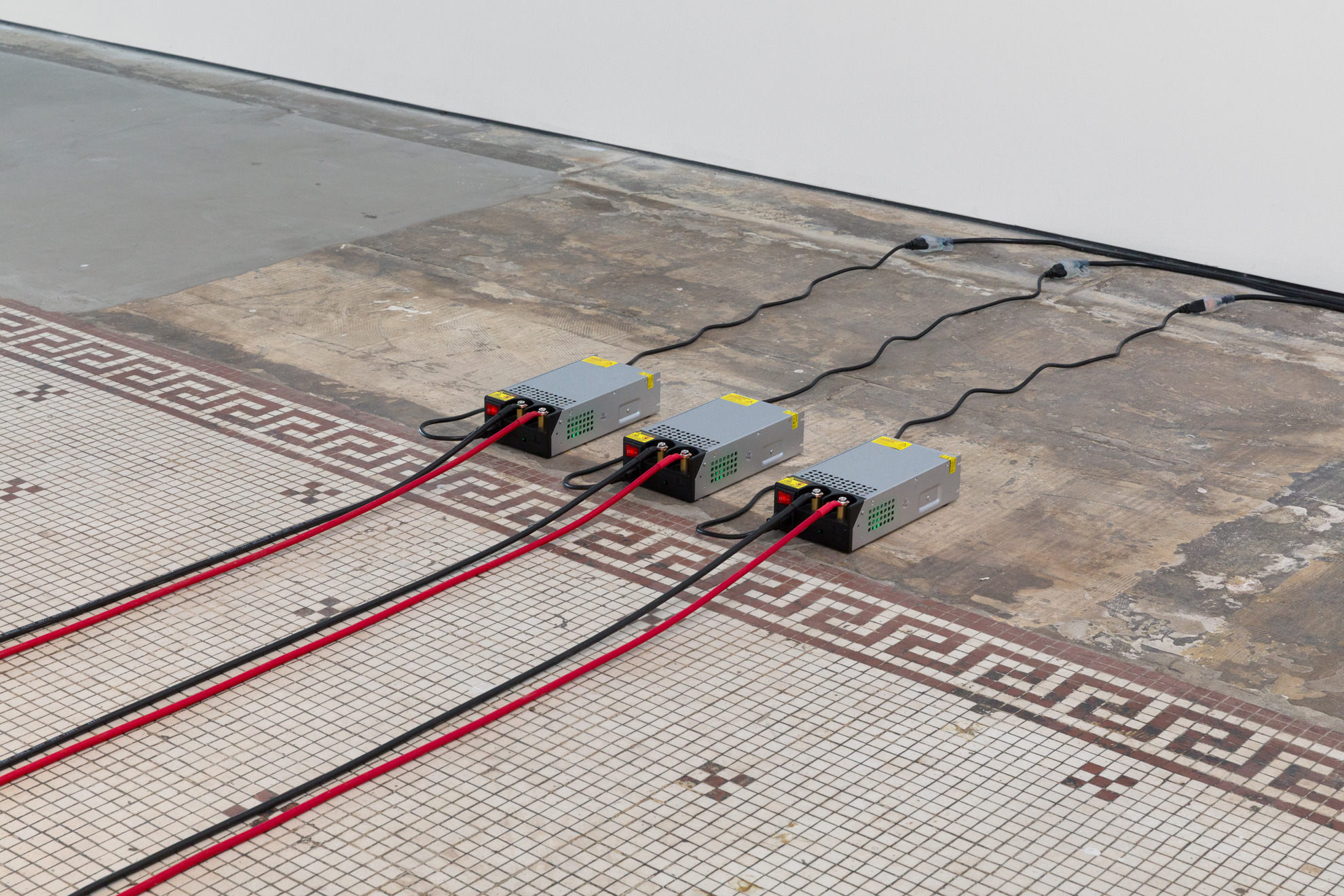
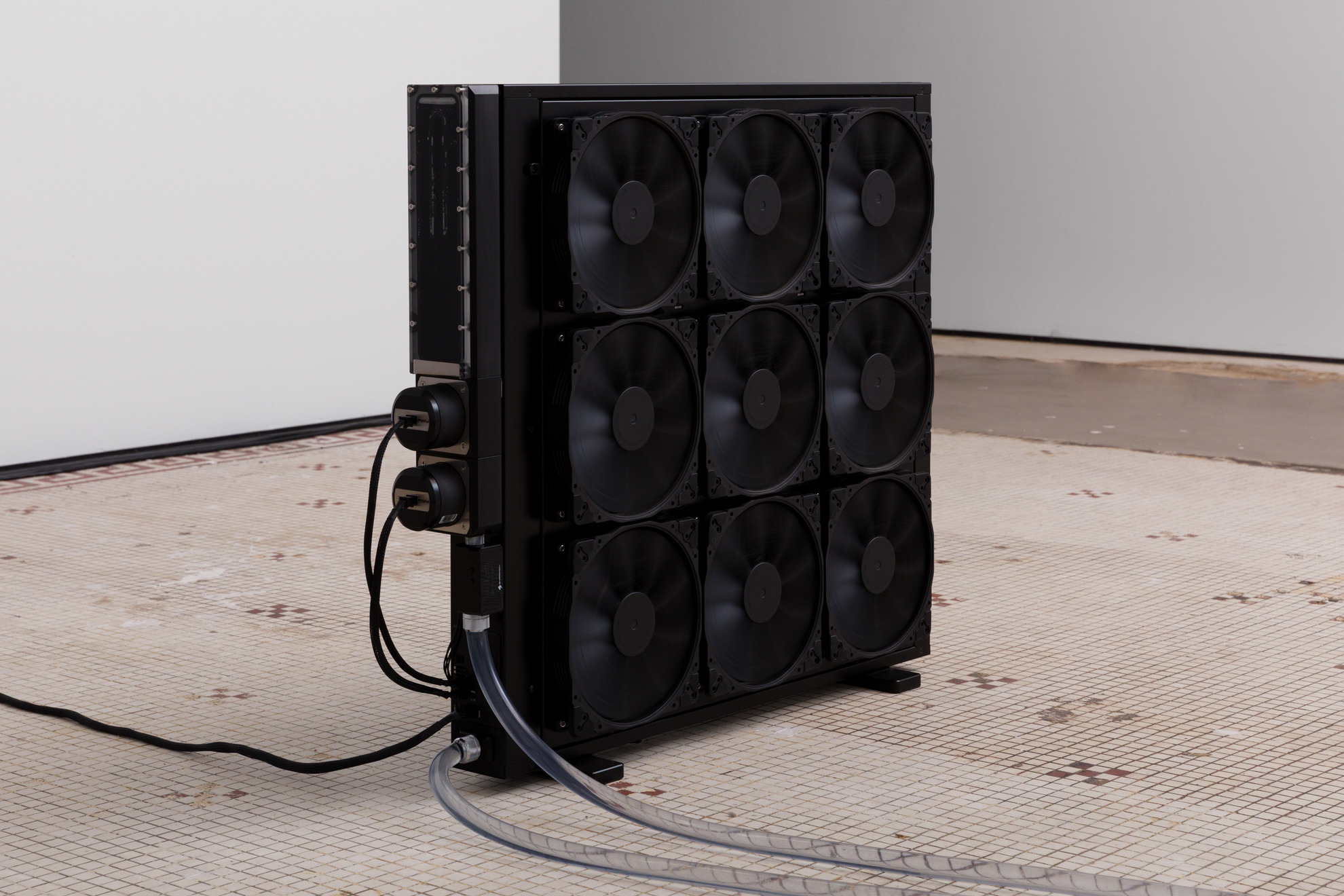
This drum set houses a set of handmade thermoelectric freezers. Electricity passes through an array of cooling modules attached to aluminum plates fitted into each of the drum’s heads. When powered, these small chips pump heat away from the metallic drumheads, bringing them to a low enough temperature such that frost forms onto them from the air. This thermal energy is absorbed into flowing coolant, where it is carried to a large, specialized PC water cooling radiator and diffused into the air. Liquid cooling systems like this are primarily designed to keep high-performance graphics cards within operational temperatures.
As a heat exchanger, the radiator relies on the second law of thermodynamics: the spontaneous flow of energy. Some work leaks away as waste and degrades into heat.
This drum set, a Ludwig Super Classic model with champagne sparkle wrap, was made in 1966.
Today: “An industrial revolution, an information revolution, and a renaissance—all at once. This is the potential that AI presents. The opportunity that stands before us is both inspiring and
humbling. And it is ours to seize, or to lose.”
The development of thermodynamics as a physical science is bound to nineteenth-century industrialism, and warfare—how to build a better steam engine. It is also bound to the recognition of a total irreversibility. It’s time’s arrow: a one-way street from order to chaos.
Through the 1960s and 1970s, American rock music—with drum beats and rhythms first wrested from military marching bands—peaked alongside American industrialism, imperialism, and assassinations.
The system produces heat. The heat enters the room. It’s irrecoverable.
~~
Some energetic models:
Behind the barricades in France in the summer of 1848 are the chômeurs and chômeuses. Having forced the king into abdication that past winter, they opened the way for the Second Republic. Promised and then denied work and a minimum income by the liberal-led Republic, given the choice instead of joining the army or leaving Paris, the chômeurs and chômeuses chose class war a second time. Unemployed artisans, chômeur·euse from the verb chômer, to be idle, out of work, is derived from the Latin, caumāre, to rest from the heat, and the Greek, kaûma, burning heat. Over four days that summer 1500 to 3000 were killed on the barricades or later executed by the National Guard. 12,000 to 15,000 were imprisoned. 4000 to 4500 were soon deported to Algeria to initiate the settlement and agricultural stage of the colonial project in North Africa.
In his 1895 essay “Project for a Scientific Psychology,” Freud outlined a psychological system as natural science. Imagined biological, his “principle of neuronic inertia” did not avoid the sway of the physical sciences. As people with “excessively intense ideas,” our neurosis is the result of a high quantity of excited neurons, and the job of our neurotic system is to get rid of this nervous energy. The one rule is to lower the tension to zero or the closest equilibrium. Work then, when you do the work, is more akin to the thermodynamic concept of work as organized, at times forced, energy transfer than labor. By 1915, Freud thought his purely biological project to be a failure, yet held on to his energetic model of flows, blockages, and discharges for the Pleasure Principle and Death Drive.
In 1939, twenty-one year old poet Muriel Rukeyser published A Turning Wind composed in the wake of her experience of the Spanish Civil War. She writes of recovering popular power as “common property.” The collection includes the poem “Gibbs” on the American physical chemist Josiah Willard Gibbs (1839-1903) who helped push thermodynamics out of its engine era and into a science of particles and substances. An excerpt:
Deduction from deduction : entropy,
heat flowing down a gradient of nature,
perpetual glacier driving down the side
of the known world in an equilibrium tending
to uniformity, the single dream.
He binds
himself to know the public life of systems.
Look through the wounds of law
at the composite face of the world.
In 1942, Rukeyser published a book-length biography of Gibbs, writing in her introduction:
The story of Gibbs is that of pure imagination in a wartime period. This is the adventure of the system-building spirit in a time of the breaking of systems, the daring “I Give You” to a future that must rise out of wounds.
And in the second to last chapter, Rukeyser writes of sociologist and economist Vilfredo Pareto (1848-1923), “far on the other side of meanings,” who draped a profane general theory of society over Gibbs’ thermodynamics. The distribution of power across lines of class and income becomes natural law. Society consists of three types of molecules—the governing elite, the non-governing elite, and the non-elite—each with their uneven share of intellectual, moral, and physical charge. The rule and power of decision in society is renewed through the circulation of the elites: moribund governing elites fall, exceptional non-governing elites rise, non-elites can only follow. All is sustained through an energetic balance of innovation and tradition. Benito Mussolini, just twenty, sat in on Pareto’s lectures at the University of Lausanne in 1904 and thought it brilliant; Pareto saw Mussolini’s later rise to power as empirical proof to his model.
The Great Sahelian drought from the late 1960s through 1970s forced the transnational region’s semi-nomadic, pastoral, and autonomous Tuareg communities out of the Sahara and into the surrounding towns and cities. This newly displaced and newly urban community carried with them a reputation for rebellion—both against the French colonial powers and newly formed African states. With rebel repute and widely unemployed, they are called (and call themselves) ishumar, a Tuareg variation of chômeur. Hoping to gain from this idle reserve, the Libyan army assembles Tuareg units. The members of guitar-driven desert blues progenitors Tinariwen meet in one of these camps.
With gratitude to Brony from ModMyMods and Daz from DazMode for PC water cooling consultation, Ed from Cold and Colder for thermoelectric refrigeration consultation, Robin Simpson and Ella den Elzen for help with transportation, and Robin Simpson for the text. Robin thanks Abhishek Kumar Sharma and Amy Lam for their edits.
Eli Coplan (b. 1992, San Diego; lives and works in New York) studied at Reed College, Portland; and the Independent Study Program, New York. Recent solo exhibitions include US TV & FILM at a. SQUIRE, London, 2024, Disney Plus, at Commercial Street, Los Angeles, 2023. Recent group exhibitions include The Aeolipile, Theta, New York (2025); Shifting, Julia Stoschek Foundation, Düsseldorf (2025); On Television, carriage trade, New York (2024); Decumanus Maximus, inge, Long Island (2024); Chadwick Rantanen, Eli Coplan, Hana Miletić, Rachel Fäth, Magenta Plains, New York (2024); Eli Coplan, Rachel Fäth, Oto Gillen, Drew Healy, Anna Rubin, b11g, New York (2024); Quad, a. SQUIRE, London (2024); Slow Dance, Stadtgalerie, Bern (2023); and Manhattan, Claude Balls Int., New York (2022).