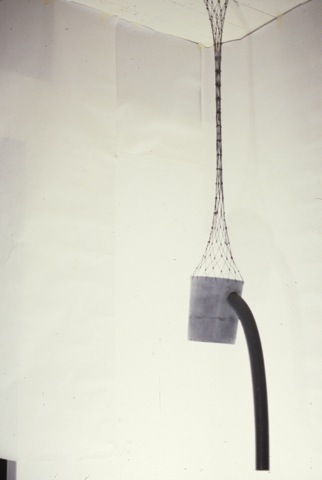
We are pleased to present 38 Years of Unplatted Space, a solo presentation of work spanning nearly 40 years of the artists practice. Please join us for an opening reception Oct 10, 5:30-7:30pm.
Late in Den Hartog’s graduate studies during the 1980’s, the artist built a floating platform in an empty gallery space that semi-precisely mirrored the surface area of that very space. Titled “Walk Around, Roll Around,” the installation consisted of hundreds of pounds of cast plaster with one pathway around the perimeter of the piece that could be traversed giving a sense of solidity to the otherwise open floorplan. This reorienting divination of form, an early but pivotal impetus, would prove foundational. The “unplatted space” of the exhibition’s title is, Den Hartog writes, “land that hasn’t been divided into legal lots through a formal, recorded subdivision map. Instead of using lot and block numbers, boundaries for unplatted land are typically described using specific measurements and directions, often called ‘metes and bounds.’” There is very little such space left in the U.S., a casualty of unbounded, industrial-scale human expansion. What remains for Den Hartog is an invented realm, form both mirroring and deviating from its earthbound counterpart. A kind of “hallucination,” hers is a systematized making of physical impossibility—the movement “between a representation, an experience and an idea” in one place.
The macro- and microcosmic building blocks of form, its “metes and bounds,” are equally explored in Den Hartog’s earliest post-graduate work. In sculptures like “Hanging Rubber Tube” and “Bunch of Black Rubber Beach Balls” (both 1988), rubber balls and tubes mirroring organelles, atoms even, bulge and droop into three-dimensional space, warping the grid of the netting that envelops them in a struggle for unbounding. Polyurethane mounds in flower shapes and garish colors ooze like cosmic magma mirroring ancient processes by which human existence is consciously and unconsciously shaped. These studio inventions followed the rapid escalation of synthetic material production across the globe, which offered new ways for the artist to experiment with scale and form and from which a new art historical movement was underway. Post-minimalists like Lynda Benglis and Helen Pashgian were already at work molding and pouring these materials into otherworldly, cosmic structures. Mary Heilman had built her “Starry Night” installation depicting a painterly astronomy more than a decade earlier. Den Hartog’s work moved through that source of fantasy with an urge to sculpt the unreal further into the realm of the real, to unify the imagined and the concrete as parallel sides of the same plane. Hers was not so much a desire to invent the unimagined as it was to make visible the heretofore invisible real.
Nietzsche’s theory of eternal recurrence offers an entry into Den Hartog’s earliest sculptural conceptions and their impact on her work through the present. Its most basic premise is the condition of human existence as an experiential loop in which everything one feels, sees, makes in a lifetime will recur ad infinitum. But rather than resignation, it invites a hyperawareness and radical embrace of lived experience. This knowledge drives one further toward reality in a sense, away, perhaps, from the fantasy of worlds other than our own. But in so doing it exalts the infinite nature of that world and the fodder it offers one willing to seize it.
Den Hartog dove headfirst toward that invitation. These shapes and materials new in their conceit behaved like earthly fundamentals—plastics flowed and hardened like tectonic, watery shifts in landscape. Their experiential qualities gave viewers a new kind of firsthand consciousness but of sights as old as time itself. So too the darkness of contemporary life sat with its beauty. The positive effects of manmade progress, advancements in materiality could not be untangled from their punishing dominance over the environment and its nonhuman cohabitants; even the circus-like, kaleidoscopic joys of “Picnic” (1991) and “Grey, Pink, and Red Pour” (1990-2026) belied the cruel treatment of animals in various kinds of human entertainment. The artist’s early embrace of all facets of this life, this world brought her closer to a vision of sculptural practice as experience grounded in the infinite, sometimes paradoxical iterations of the real.
In conjuring “space” left unplatted, Den Hartog developed her own phenomenology rooted in earthly and aesthetic fundamentals, and in the early 1990s her work became increasingly representational. “Never Land” (1992) depicts two structures of plaster separated by a clear blue body of polyurethane “water.” The structures were modeled after Neuschwanstein Castle in Bavaria commissioned by King Ludwig II and on which the Cinderella Castle at Disneyland is based. Here Den Hartog began her interest in building perspectival space into the art object and rooting its making in a cultural history. Rather than replicating or modeling the castle itself, she sought to capture in object-scale three dimensions the physical experience she had of viewing the castle from afar on a trip to Bavaria. This fealty to lived experience, to visual and physical properties of matter, was an early step toward a systematized representation that would soon unite with her deep interests in art history.
The Mustard Seed Garden Manual of Painting, an ancient Chinese artmaking guide begun in the 15th Century and the subjects of which she encountered on multiple trips to China, broke open Den Hartog’s latent interest in the history of painting and its possibilities for informing her sculptural practice. The Manual’s depictions of landscape as idealized forms or memories, often in stark contract to those in Western painting that prioritize realism, became foundational. Works like “Traveling with Mist and Vapor” (1995) build a three-dimensional viewing experience of the Manual’s pages with those materials she mastered earlier in her career. The physical properties they possessed, their ability to meld and veil like their natural counterparts she sought to depict were evidence of this new unity in her practice. In the same way she atomized rubber and net or reimagined a gallery floor, she imbued these landscape works with an experiential truth, a reinvention of but fealty to their source material.
Den Hartog’s revolutionary treatment of landscape in three-dimensional art would continue for two decades. Deeper still than her more formal interest in art history were the artist’s childhood memories of family trips across the Western U.S. This progression from collective to individual memory led to a more abstracted treatment of her subject matter. In the same way that the reality of places remembered in the mind’s eye shifts, so did her depictions of them in sculpture. The landscape and abstraction became nearly indistinguishable in works like “I Just Don’t Know What to Do With Myself” (2011), line flattening topography. And in the sculptures of Medardo Rosso, an Italian artist working at the turn of the 20th century, Den Hartog’s personal memory and art historical interest met. Having encountered one of his roughhewn wax covered busts on an adolescent trip to the Portland Art Museum, she maintained reverence for his ability to essentialize the effects of light and atmosphere on human form throughout her career. This preoccupation with mutable conditions captured in a static object was employed by Den Hartog to, perhaps, its most dramatic effect during this period in an exhibition titled “Blood and Bones” at Pasadena City College. Here she incorporated large-scale landscape sculptures depicting the flow of water through rock formations. Formed by building and carving layers of aqua resin over aluminum mesh and fiberglass cloth, they tower haltingly over the viewer as if frozen mid-break, frothing and splitting in a still charge. One such work, “Holy Jim Falls” (2017), features an almost iridescent red canyon, the suggestion of blood and bone and light a possible homage to the humanity that remains in our experience of landscape in memory, and to Rosso himself. That notion of circularity in human experience, and Nietzsche’s entreaty to recognize the power therein, is manifest in these works. It’s a grounding in the systems that operate without regard to wishes and desires—memory, gravity, volume—an exalting of the infinite real.
Then, on Easter Sunday of 2017 in a Los Angeles city park, a thirteen-year-old boy fell twenty-five feet down into a large sewer drainpipe. He was carried by the flow of water over a 12-hour period and emerged alive under a busy freeway nearly a mile away. The search and rescue mission captivated Den Hartog, an artist already transfixed by the human experience of natural phenomena and its physicality, its material manifestations. She began moving through that urban subterranean in her own mind, a layer beneath the landscapes to which she’d been dedicated. She saw her own city and its infrastructure as reflective of the same properties and potentialities of visual experience with which she began her career, its existence made possible only through the delivery of water across vast landscapes. This space, undesirable, ignored and yet essential for the survival of millions of people, was the ultimate kind of abstracted reality where light and form and all the interplays of aesthetics met necessity and ecological inevitability.
Since that time, Den Hartog has been experimenting with parallel sculptural systems that capture this surreal underworld. Those deep art-historical influences remain but are now completely abstracted. The strata of these works are poured and shaped over long periods of time in the studio, built around and through hollow space where light moves as it would beneath the city or in a ruin. The structure of a work like “Lamentations” (2023) calls to mind Corbusier’s Chapel at Ronchamp, a visit there by the artist formative for the space’s ability to sublimate so many facets of human experience, “the listening ear, the shell, and how he used feminine energy inspired by the Cult of Mary;” this sculpture embodies the refrain of life, the movement through and back around as in eternal recurrence. Simultaneously it haunts with the suggestion of a war-torn infrastructure, an all-too-familiar sight and one so lodged in the depths of (in)humanity as to recall Jerusalem in the Book of Lamentations—the city itself weeping for its devolution into bloody unmaking.
This journey beneath representation into the bowels of phenomenological anatomy, the core of human experience, is a return for the artist to the origins of her practice. These fundamental building blocks of form and shape, made with synthetic materials that mirror those in nature, are practically mitochondrial in their generative center. “Lure” (2025) consists of a spherical form wrapped in a sheath of pigmented polyurethane. It sits at the entrance of the exhibition, a literal manifestation of its title, and essentializes Den Hartog’s singular ability to subsume all earthly experience into her art object—an orchestration of all the fecundity of the human and natural worlds, an overwhelming output with which most cannot contend. And in the same way, the art history with which artist and viewer alike are burdened is here exploded onto reality. The staid two-dimensionality of painting, its ossified perspective, is made molten and forced into the worst and best of physical, lived experience. This work is no less true in its making than erosion or sedimentation or eruption. In “Hypersurface” (2025) the artist brings that experience even closer to two dimensions, almost tempting the flatness with which we now encounter most of our world. Its mass pools and undulates as if in resistance to the very state in which it now rests. Den Hartog’s work embodies experience because it is itself experience.